 Skip to main content
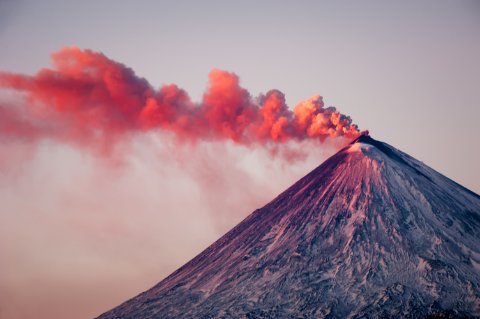
Nearly 200 years ago, a massive volcano eruption caused a global cooldown of approximately one degree Celsius, but no one knew where the mystery eruption originated from.
Now, in a publication released on Monday (30 December) in the Proceedings of the National Academy of Sciences, researchers from the University of St Andrews in Scotland revealed that the 1831 eruption occurred on a remote, uninhabited island currently disputed between Russia and Japan.
The researchers, who were able to find a “perfect fingerprint match” for the ash deposits from the eruption by chemically analysing ice core records, located the event to the Zavaritskii volcano on the island of Simushir, part of the Kuril Islands. Currently, these islands are used as a strategic military outpost by Russia.
The study was led by Dr Will Hutchinson from the School of Earth and Environmental Science at the university, who said: “Only in recent years have we developed the ability to extract microscopic ash shards from polar ice cores and conduct detailed chemical analyses on them. These shards are incredibly minute, roughly one-tenth the diameter of a human hair.
“We analysed the chemistry of the ice at a very high temporal resolution. This allowed us to pinpoint the precise timing of the eruption to spring-summer 1831, confirm that it was highly explosive, and then extract the tiny shards of ash.
“Finding the match took a long time and required extensive collaboration with colleagues from Japan and Russia, who sent us samples collected from these remote volcanoes decades ago,” he added.
The Zavaritskii volcano eruption, while very remote, had a significant global impact on climate and severe consequences for human populations, the researchers said. They believe that identifying the sources of these mystery eruptions is crucial, as it allows scientists to map and monitor the regions on Earth most likely to produce climate-altering volcanic events.
Last year, a volcano in Iceland erupted seven times following a swarm of earthquakes which hit the Reykjanes peninsula in late 2023, prompting experts to warm that the peninsula is likely to experience repeated volcanic outbreaks for decades.
Suhasini Srinivasaragavan
This article originally appeared on www.siliconrepublic.com and can be found here
Now, in a publication released on Monday (30 December) in the Proceedings of the National Academy of Sciences, researchers from the University of St Andrews in Scotland revealed that the 1831 eruption occurred on a remote, uninhabited island currently disputed between Russia and Japan.
The researchers, who were able to find a “perfect fingerprint match” for the ash deposits from the eruption by chemically analysing ice core records, located the event to the Zavaritskii volcano on the island of Simushir, part of the Kuril Islands. Currently, these islands are used as a strategic military outpost by Russia.
The study was led by Dr Will Hutchinson from the School of Earth and Environmental Science at the university, who said: “Only in recent years have we developed the ability to extract microscopic ash shards from polar ice cores and conduct detailed chemical analyses on them. These shards are incredibly minute, roughly one-tenth the diameter of a human hair.
“We analysed the chemistry of the ice at a very high temporal resolution. This allowed us to pinpoint the precise timing of the eruption to spring-summer 1831, confirm that it was highly explosive, and then extract the tiny shards of ash.
“Finding the match took a long time and required extensive collaboration with colleagues from Japan and Russia, who sent us samples collected from these remote volcanoes decades ago,” he added.
The Zavaritskii volcano eruption, while very remote, had a significant global impact on climate and severe consequences for human populations, the researchers said. They believe that identifying the sources of these mystery eruptions is crucial, as it allows scientists to map and monitor the regions on Earth most likely to produce climate-altering volcanic events.
Last year, a volcano in Iceland erupted seven times following a swarm of earthquakes which hit the Reykjanes peninsula in late 2023, prompting experts to warm that the peninsula is likely to experience repeated volcanic outbreaks for decades.
Suhasini Srinivasaragavan
This article originally appeared on www.siliconrepublic.com and can be found here

.jpeg?width=480&height=auto&maxsidesize=480&ext=.jpeg)
